


 English
  Spanish


(1) Key Parameters of Hydraulic Cylinders
1.1 Force
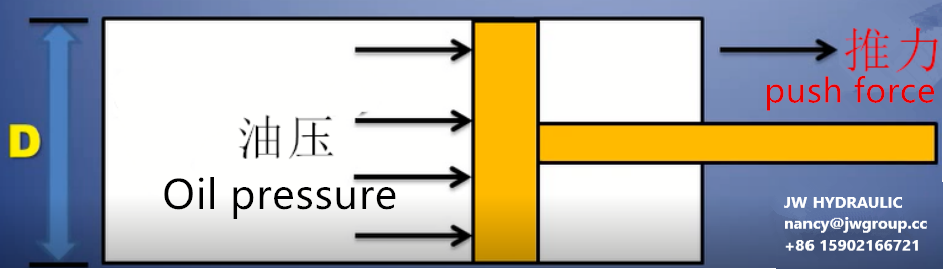
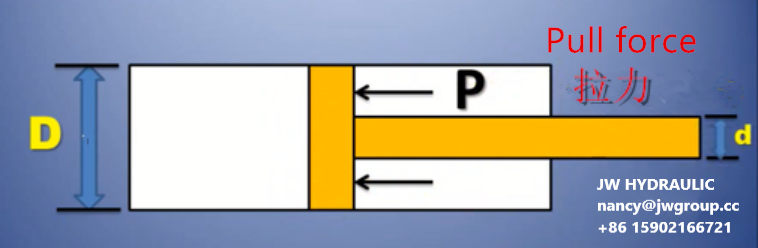
To push the load, the hydraulic cylinder needs a certain force from the hydraulic system, that is, the force. The force of the hydraulic cylinder is divided into push force and pull force.
Push force refers to the oil pressure when the piston rod extends, and pull refers to the oil pressure when the piston rod retracts.
1.2 Cylinder barrel diameter
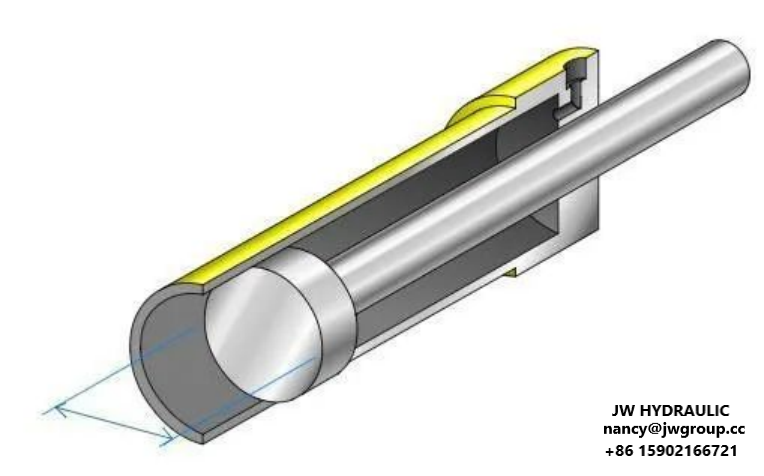
In the hydraulic system, what we need to consider is the effective area of the parts in contact with the oil, that is, the piston area, that is, the size of the cylinder barrel diameter needs to be determined.
1.3 Pressure
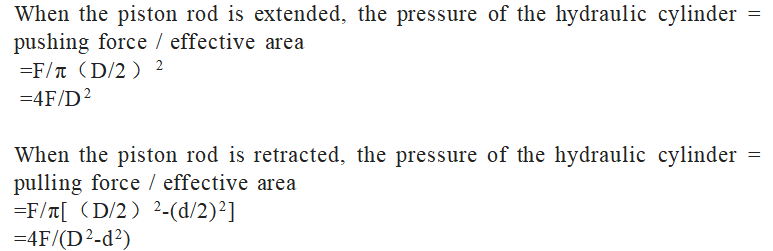
The hydraulic cylinder is the executive element of the hydraulic system, and the hydraulic cylinder produces movement only after the hydraulic system provides a pressure source.
(2) The relationship between force, pressure and cylinder barrel diameter
2.1 Force
When the piston rod is extended, the effective area of the hydraulic oil is the cross-sectional area of the cylinder.



2.2 Pressure

2.3 Cylinder barrel diameter
Knowing the system pressure and the force transmitted by the system, the size of the piston area can be calculated, and then the size of the cylinder bore can be calculated.
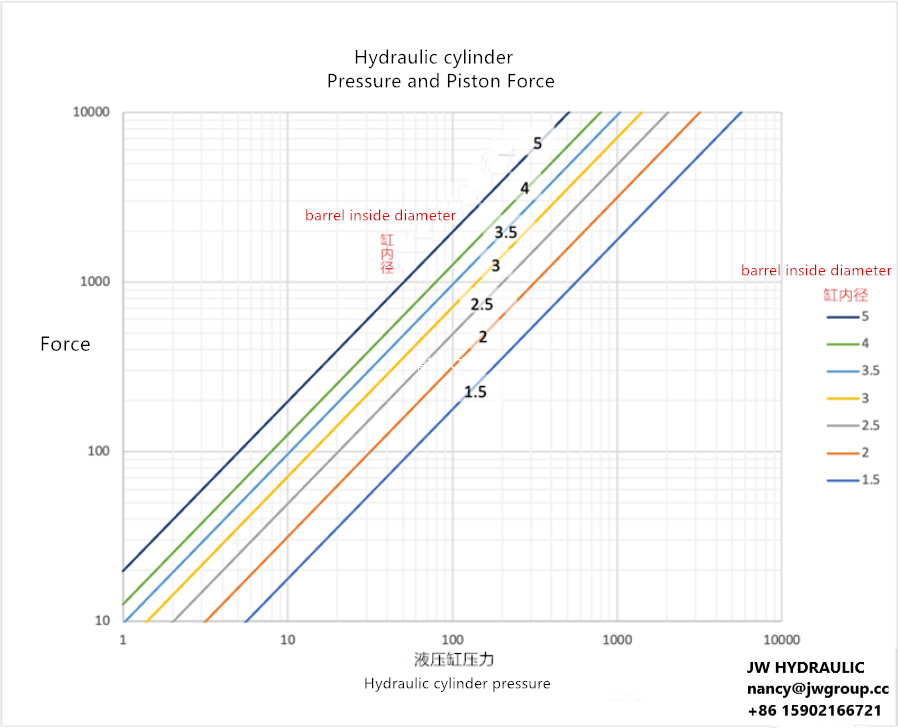
Under the same pressure, the larger the cross-sectional area, the greater the force, that is, the larger the cylinder diameter, the greater the thrust; under the same cylinder diameter, the greater the pressure, the greater the force.
(3) How to choose pressure and cylinder diameter?
First of all, the push force is determined according to the load, and the push force of the hydraulic cylinder should have a little margin.
After the push force is determined, the pressure and cylinder diameter are determined according to the formula F=PS. Please refer to the table below:

Selection method: confirm the data that the push force is slightly larger than the load, and the ordinate and abscissa corresponding to the data are the cylinder bore and pressure.
Assuming that a certain equipment needs to push a load of 20 tons, first find a push force exceeding 20,000kg, as shown in cell ① in the following figure, the corresponding ordinate of 150 is the cylinder diameter, and the abscissa of 140kgf/cm2(14Mpa) is the pressure.

As can be seen from the above table, there are many choices of cylinder bore and pressure to meet the push force of 20 tons, and there are ②③④⑤, and more other data can be found.
Which to choose? ? ?
Let’s take a look at the advantages and disadvantages of different options.
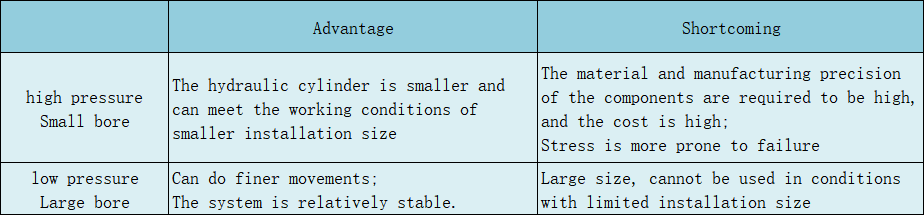
In general, under the premise of meeting the requirements, choose a smaller pressure. For equipment with unlimited size, the pressure can be lower; for heavy-duty equipment of mobile machinery, the pressure should be higher.
In actual work, we can also refer to the following materials to help in the selection.
Select design pressure according to load:

Select design pressure according to host type:

In general, in addition to the size of the load, the selection of hydraulic cylinders also needs to consider factors such as the type of equipment, the assembly space of the actuator, and economic conditions.

Sales manager:Miss Nancy
Email: nancy@jwgroup.cc
Mobile/Whatsapp:+86 15902166721
HYDRAULIC CYLINDER specialist, maritime wind turbine installation vessel hydraulic cylinder, marine&offshore hydraulic cylinder. Classfication: ABS,DNV,LR,NV,GL,RINA,KR,NK,RS,CCS.
JW GROUP is an integrated steel product group,subsidiary JW STEEL/JW HYDRAULIC products include:hydraulic cylinder, hydraulic cylinder spare parts, drilling forging parts, pneumatic actuator-scotch yoke, machinery part